
When AI Becomes a Second Pair of Hands for Case Managers - Integrated Information Management System for Occupationally Injured Workers
Biomedical Artificial Intelligence Academy, Kaohsiung Medical University
In the field of occupational health, there is a number that has long been overlooked: an estimated 50% to 95% of occupational diseases worldwide are never reported. The reason is often not unwillingness to report, but simply that there is not enough time. Frontline case managers must complete interviews, documentation, interpretation, form filling, and follow-up within a limited amount of time. Simply turning a conversational interview into a standardized record can take several hours. The administrative burden is consuming time that should instead be devoted to caring for workers.
To address this challenge, Professor Hao-Yun Kao’s team from the Department of Healthcare Administration and Medical Informatic at Kaohsiung Medical University developed the “Integrated Information Management System for Occupationally Injured Workers.” The study was based on Design Science Research Methodology (DSRM) combined with design thinking, placing the everyday challenges faced by case managers at the center of system design. The system was implemented in a regional teaching hospital in southern Taiwan whose service area covers more than 2,000 factories.
The key to the system lies in its three-stage “human–machine collaboration” design. The first stage is structured input, using error-prevention fields to replace cumbersome paper forms. The second stage incorporates AI speech recognition and large language models, allowing conversations during interviews to be transcribed into text in real time and automatically generating draft standardized summaries. The third stage is human verification-the AI output is always only a draft, and case managers must review, modify, and approve each item before it can be officially exported. Clinical judgment remains entirely in the hands of professionals, while AI is responsible only for the parts it can perform more efficiently. The system also includes automated follow-up reminders at 3, 6, 12, and 24 months, reducing the risk of losing contact with workers undergoing long-term rehabilitation.
The initial implementation results are highly encouraging: the processing time for a single case was reduced by approximately 60% to 70%, while the System Usability Scale (SUS) score reached 85, placing it in the “excellent” range. This indicates that the interface is intuitive and requires little to no learning curve. Case managers can step away from the fatigue of data entry and devote more time to the workers who genuinely need their support.
Looking ahead, the team has identified three directions for further development. First, the team will strengthen privacy protection mechanisms in preparation for expansion to cloud-based environments. Second, it will develop interfaces for connecting hospital information systems with government reporting databases, enabling data to be transferred and integrated more efficiently. Third, the team will continue to enhance speech input technology so that on-site interviews can be transformed more naturally into structured records.
More importantly, this framework has strong potential for replication. Clean and standardized reporting data can support more accurate epidemiological analyses and evidence-based labor policies. Meanwhile, the “AI accelerates, humans oversee” design model could potentially be extended to specialties such as mental health and chronic disease care, where administrative and documentation workloads similarly place significant pressure on healthcare professionals. It may ultimately serve as a trusted model for the adoption of generative AI in real-world healthcare settings.
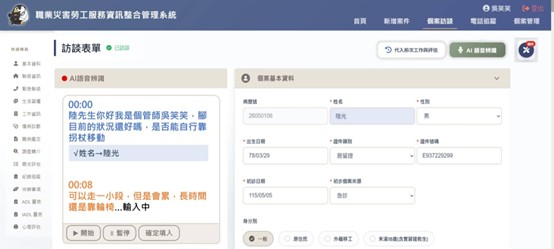
Figure 1: The system’s “AI Speech Recognition Interview Form” interface — interview conversations are transcribed into text in real time and automatically mapped to structured fields,
which are then completed after verification by the case manager.
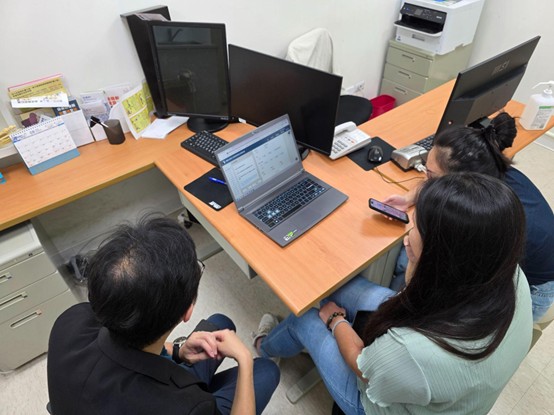 .
Figure 2: The team conducting an on-site visit at Siaogang Hospital, working with frontline case managers to test the system’s operational workflow.