
Understanding New Challenges in Dementia Care Through the Lens of Complex Care Needs
Affiliation: Neuroscience Research Center
As the population ages, older adults may face not only dementia but also complex medical and care needs, such as tube feeding, respiratory care, urinary catheterization, wound care, and other forms of advanced care. However, nationwide evidence on the relationship between complex care needs and dementia remains limited. This study conducted a large-scale, population-based survey across all 22 cities and counties in Taiwan, involving 11,297 adults aged 65 and older. The study examined dementia and behavioral and psychological symptoms among older adults with different levels of care needs, and its findings were published in the international journal The Journal of Prevention of Alzheimer’s Disease.
The study found that 18.0% of older adults receiving at least one type of advanced care had dementia, compared with 8.0% among those without advanced care needs. Moreover, the prevalence of dementia increased as the number of advanced care needs increased. Older adults with advanced care needs were also more likely to experience cognitive difficulties and certain behavioral and psychological symptoms, particularly day–night confusion and care-resistant behavior. These findings highlight that when older adults require more complex medical and daily care, healthcare and care professionals should pay attention not only to their physical needs but also to changes in cognitive function and behavior. Early recognition of dementia may allow appropriate support and care to be provided in a timely manner.
The significance of this study extends beyond describing the current status of dementia among older adults with advanced care needs in Taiwan. It highlights the importance of incorporating cognitive and behavioral assessments into routine care for older adults with complex care needs. Future efforts may focus on developing personalized non-pharmacological interventions, including strategies targeting sleep, physical activity, nutrition, and daily routines, while integrating resources across hospitals, long-term care facilities, and communities to reduce the burden on caregivers. Digital health and artificial intelligence may also provide opportunities to develop tools for early dementia risk identification and smart care, helping care professionals recognize changes in older adults at an earlier stage and advancing more precise, integrated, and person-centered dementia care.

▲ From Research Findings to Integrated Care
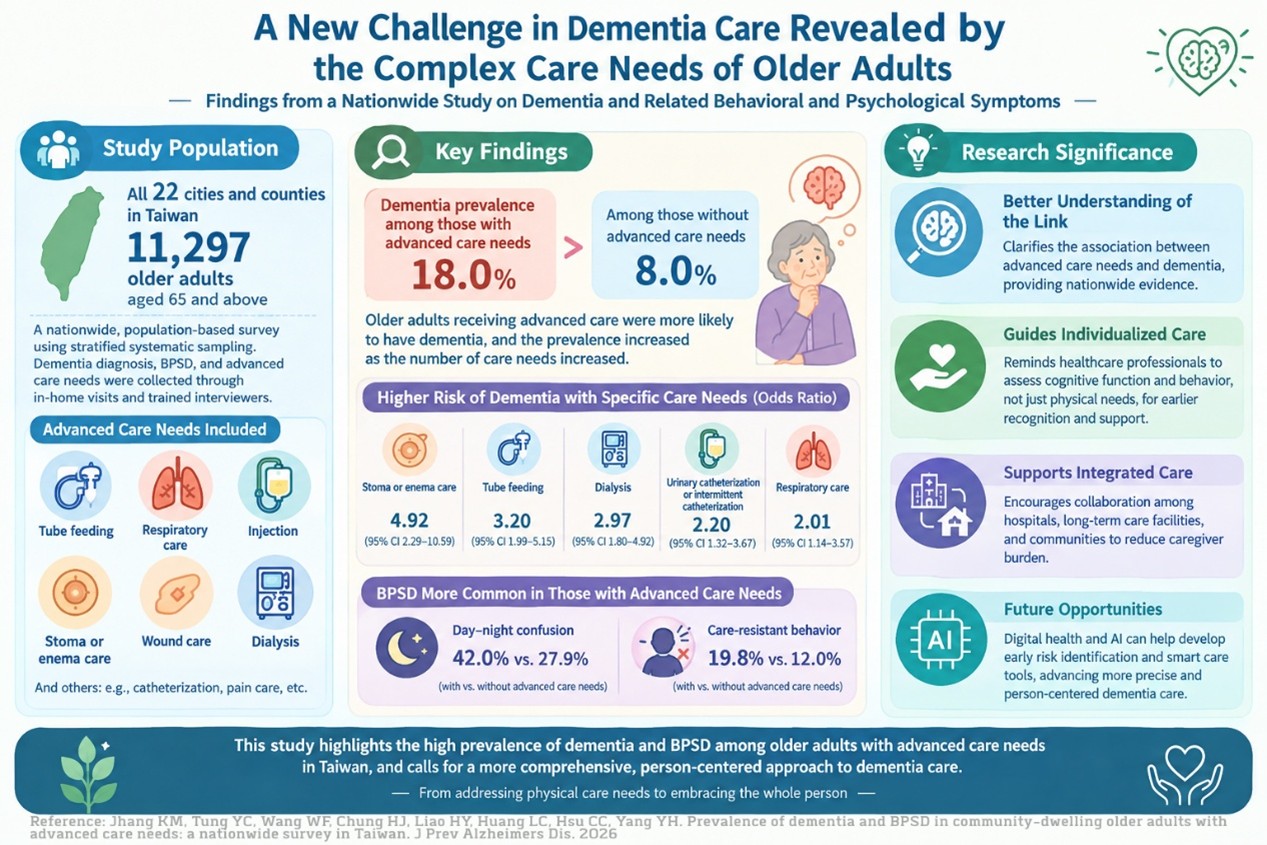
▲A New Challenge in Dementia Care Revealed by the Complex Care Needs of Older Adults
Reference: Jhang KM, Tung YC, Wang WF, Chung HJ, Liao HY, Huang LC, Hsu CC, Yang YH. Prevalence of dementia and BPSD in community-dwelling older adults with advanced care needs: a nationwide survey in Taiwan. J Prev Alzheimers Dis. 2026 Aug 14;13(9):100656. doi: 10.1016/j.tjpad.2026.100656. Epub ahead of print. PMID: 42600202; PMCID: PMC13499164.