
Interdisciplinary Breakthroughs at KMU: Dengue Surveillance, Botanical Antivirals, and Ultra-Sensitive Diagnostics
Affiliation: Center for Tropical Medicine and Infectious Disease Research
1. Key Research Discoveries and High-Impact Publications
In response to global climate change and emerging infectious diseases, Kaohsiung Medical University (KMU) has achieved major scientific breakthroughs across epidemiological surveillance, natural product antivirals, and clinical diagnostics:
- Unraveling Taiwan’s 2023 Dengue Outbreak (Prof. Sheng-Fan Wang’s Team) Taiwan experienced its largest dengue outbreak on record in 2023, recording 26,706 confirmed cases. By integrating ten years of surveillance data, meteorological records, mosquito density indices (Breteau Index), and whole-genome sequencing, Prof. Sheng-Fan Wang’s team confirmed that the outbreak was driven by imported strains from Southeast Asia co-circulating with DENV-1 and DENV-2 serotypes. Crucially, the study revealed distinct transmission drivers between cities: transmission in Kaohsiung was jointly driven by temperature, rainfall, and vector density, whereas Tainan was primarily driven by rainfall and time-lagged imported cases. This milestone study was published in Open Forum Infectious Diseases (2026) and Journal of Infection and Public Health (2025).
- In Vitro Validation of Honeysuckle Against Live SARS-CoV-2 (Prof. Ying-Ray Lee & Director Jih-Jin Tsai’s Team) Ying-Ray Lee and Director Jih-Jin Tsai’s team validated the antiviral potency of honeysuckle (Lonicera japonica Thunb.) in a Biosafety Level 3 (BSL-3) laboratory using clinically isolated SARS-CoV-2 virions. The study proved that honeysuckle extracts induce host microRNAs (such as let-7a) and reduce viral RNA levels and infectious titers by over 99.6% during pre-treatment, while attenuating inflammatory responses. Published in Frontiers in Pharmacology (2025), this research establishes a strong scientific foundation for botanical antiviral strategies.
- TN-cyclon™ Ultra-Sensitive Diagnostic Platform (Dr. Po-Liang Lu’s Team) Lu’s team developed the "TN-cyclon™" ELISA platform using thio-NAD cycling amplification, boosting detection signals by over 50-fold and improving the limit of detection (LOD) by more than 30-fold compared to traditional ELISA. Evaluated on 90 clinical Neisseria gonorrhoeae isolates, its positive detection rate reached 78.9% (vs. 30.0% for traditional ELISA), maintaining high specificity in complex matrices like urine and saliva.
2. Future Impact and Translational Prospects
- Academic Development & Climate Early Warning: The dengue findings underscore the urgent need for region-specific vector surveillance and climate-based early warning systems to predict future epidemic waves.
- Natural Product Commercialization: The honeysuckle research establishes a clear translational pipeline from molecular mechanisms to botanical dietary supplements and preventative antiviral agents.
- Public Health & POCT Commercialization: The culture-free, rapid, and low-cost TN-cyclon™ platform possesses tremendous potential for point-of-care testing (POCT) bio-chip development, serving as a cost-effective precision tool for resource-limited regions.

Figure 1: Multifactorial Drivers and Regional Heterogeneity of the 2023 Dengue Epidemic in Taiwan
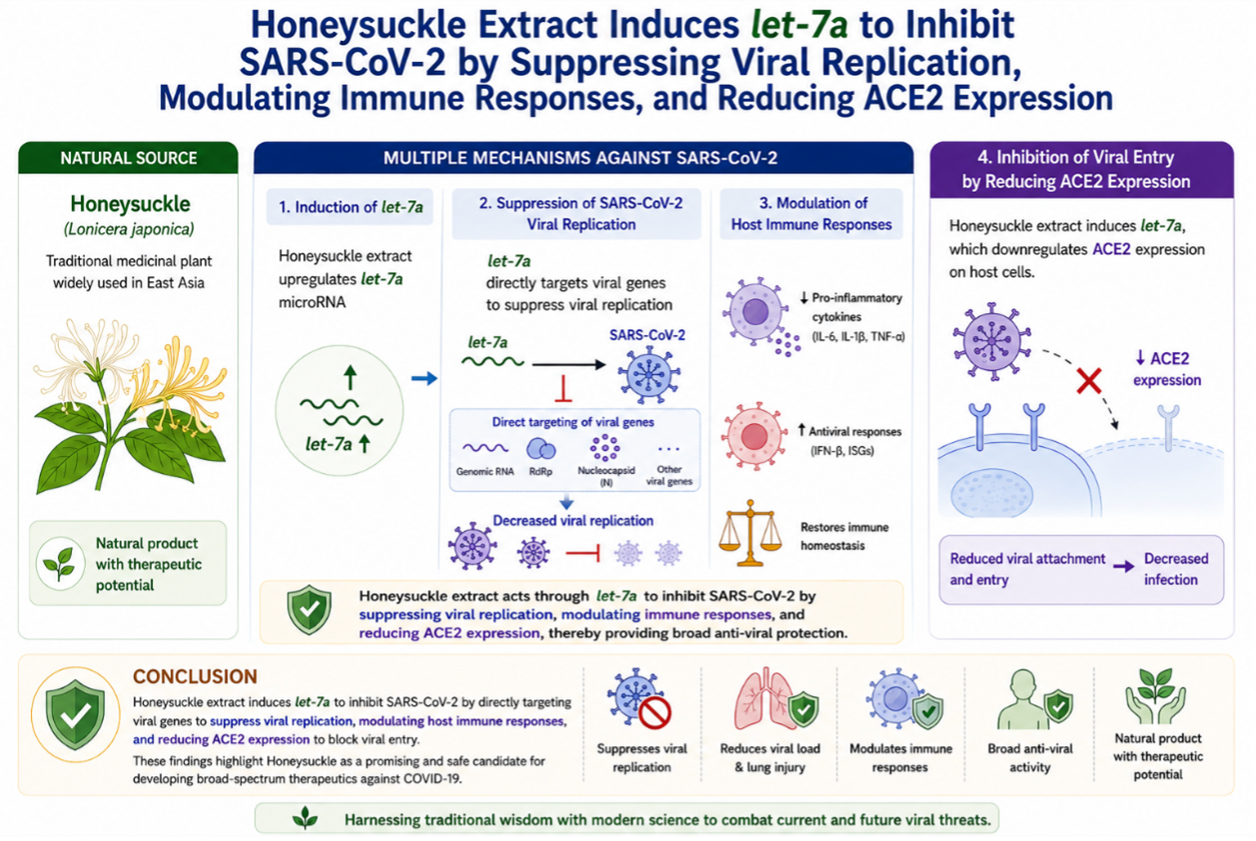
Figure 2: Multi-Pronged Antiviral Mechanism of Honeysuckle Extract Against SARS-CoV-2 via Host microRNA (let-7a) Induction